March 15, 2024
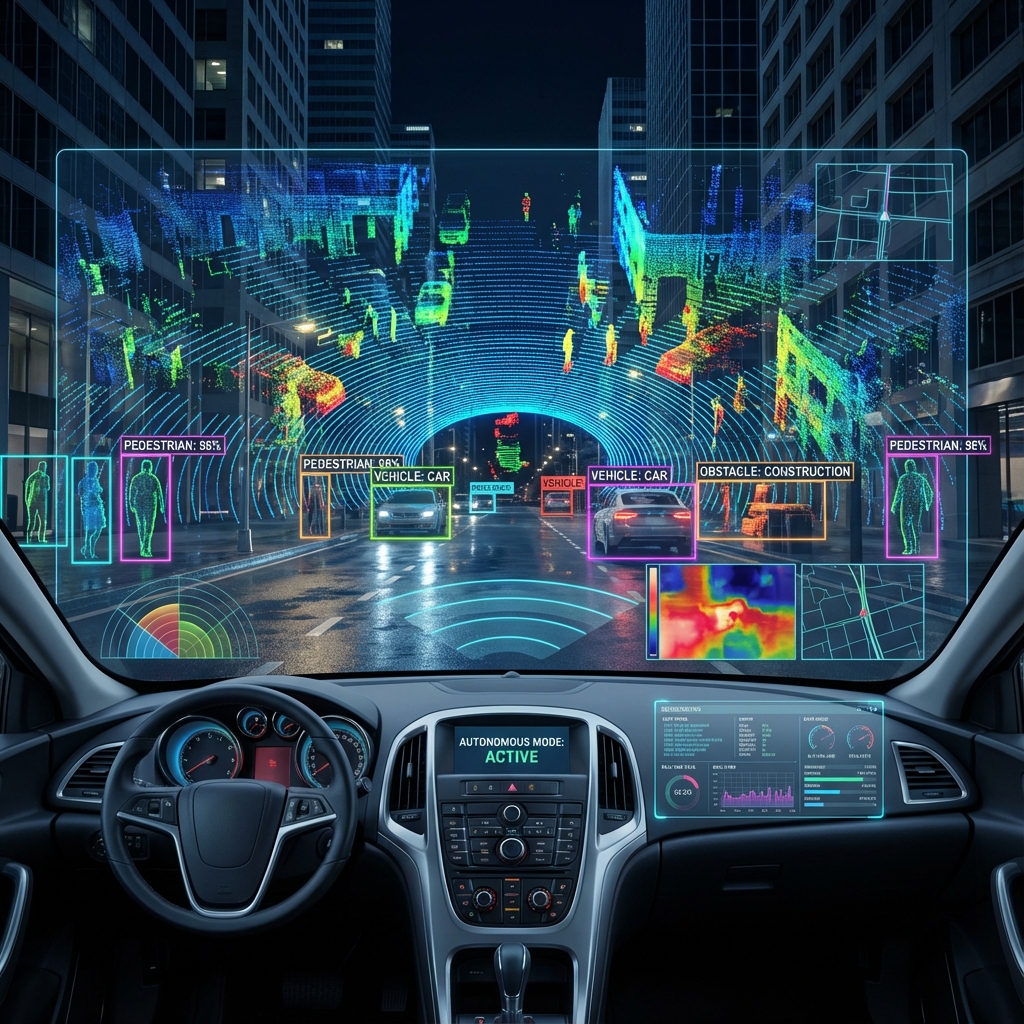
Advanced Driver Assistance Systems (ADAS) sit where perception meets liability: cameras and lidar must agree enough of the time that planners can act under rain, glare, vibration, and weird edge cases you never get in a lab demo.
Real roads are rude
Traditional vision stacks break outside curated datasets because the world is adversarial in boring ways: sunstrike, spray, sensor shake, and overlapping clutter at highway speeds. ADAS needs perception that stays calibrated across those shifts while teams can still trace failures.
Key challenges include:
- Multi-modal sensor fusion: Combining cameras, LiDAR, radar, and ultrasonic sensors
- Real-time processing: Decisions must be made in milliseconds
- Consistency across conditions: Performance cannot collapse when weather or lighting shifts
- Safety-critical applications: Failures can have catastrophic consequences
Fusion is a trust problem
Sensor fusion is not just "use more sensors." Each sensor has a different failure mode, and the system has to know when to trust one more than another.
- Cameras: Rich visual information and object recognition capabilities
- LiDAR: Precise distance measurements and 3D mapping
- Radar: Reliable detection in adverse weather conditions
- Ultrasonic: Close-range obstacle detection for parking and low-speed maneuvers
The fusion process involves:
- Sensor calibration: Ensuring accurate spatial and temporal alignment
- Data preprocessing: Filtering noise and compensating for sensor limitations
- Feature extraction: Identifying relevant objects and environmental features
- Decision fusion: Combining sensor outputs so downstream logic sees one coherent scene
Where ML helps, and where it gets dangerous
Deep learning reshaped ADAS perception stacks by handling messy sensor stacks end-to-end where hand-built fusion could not scale. That unlocked:
- Object detection and classification: Identifying vehicles, pedestrians, cyclists, and road infrastructure
- Semantic segmentation: Understanding the spatial layout of the driving environment
- Behavior prediction: Anticipating the actions of other road users
- Path planning: Determining safe and efficient routes
The hard part is deploying those models where mistakes matter:
- Model interpretability: Understanding how decisions are made
- Scenario coverage: Stressing models across weather, pose, and map drift
- Fail-safe mechanisms: Handling model failures gracefully
- Regulatory compliance: Meeting automotive safety standards
Where the interesting work is
The future of ADAS perception lies in:
- End-to-end learning: Training models to directly map sensor inputs to driving actions
- Continual learning: Adapting to new scenarios and environments over time
- Edge computing: Processing perception algorithms on vehicle hardware
- V2X communication: Sharing perception data between vehicles and infrastructure
As ADAS stacks absorb more autonomy, perception stops being “accuracy on a leaderboard” and becomes traceable evidence for planners and regulators: what did each sensor contribute when the model disagreed with physics?
The interesting work lives in fusion hygiene, calibration drift, and knowing when to hand uncertainty upward instead of faking confidence.
If you want applied robotics context from the same era of work, see the UBC autonomous systems project.